




Infrared Sauna for Menopause: Natural Relief for Hot Flashes, Sleep, and Mood
Infrared Sauna for Menopause: Natural Relief for Hot Flashes, Sleep, and Mood
Menopause is not a single event. It is a transition that can stretch across a decade, and the symptoms that come with it — hot flashes, night sweats, broken sleep, joint stiffness, mood swings, brain fog — rarely arrive one at a time. For women who cannot or choose not to use hormone therapy, the search for relief often turns into a long list of half-measures.
Heat therapy and red light therapy have both drawn research interest here. Neither treats menopause, and neither replaces medical care. But both act on systems menopause disrupts: thermoregulation, sleep architecture, circulation, and skin tissue health. That overlap is why a growing number of women are building a home routine around a steam sauna and an infrared panel rather than a single product.
Here is what the research suggests, where the limits are, and how a combined protocol tends to be structured.
Why Heat Exposure Interests Researchers Studying Menopause
The hot flash is a thermoregulatory event. During the menopause transition, declining estrogen appears to narrow what researchers call the thermoneutral zone — the range of core body temperature a person can sit in comfortably before the body triggers cooling behavior like sweating and vasodilation. When that window narrows, a small rise in core temperature that would once have passed unnoticed can set off a full flushing response.
This is where the research on heat acclimation becomes interesting. Repeated, controlled heat exposure — the kind produced by regular sauna sessions — is well documented in exercise physiology to produce measurable adaptations: earlier onset of sweating, greater plasma volume, improved skin blood flow, and better cardiovascular stability under thermal load. In athletes, these adaptations are the point. In the context of menopause, researchers have asked whether widening thermal tolerance could reduce how disruptive a given flash feels.
The honest answer is that the direct evidence is thin. Most heat acclimation research has been conducted in athletic and occupational populations, not in menopausal women, and the few studies on sauna use and vasomotor symptoms are small and mixed. Some women report that regular sauna use makes flashes feel less jarring; some report the opposite in the hours right after a session. Personal response matters more here than a population average.
Better established is the downstream effect on sleep. Passive heat exposure in the evening produces a core temperature rise followed by a pronounced drop during cooling, and that falling-temperature curve is one of the cues the body uses to initiate sleep. Studies on warm bathing and passive body heating before bed have consistently shown shortened time to fall asleep and improved subjective sleep quality. Sauna use follows a similar thermal pattern.
Where Red Light Therapy Fits
Red light therapy — more precisely, photobiomodulation — works on an entirely different mechanism. Rather than raising body temperature, specific wavelengths of red and near-infrared light penetrate skin and underlying tissue, where they are absorbed by cytochrome c oxidase in the mitochondrial electron transport chain. The downstream effects documented in laboratory and clinical research include increased ATP availability, modulated reactive oxygen species signaling, and changes in local inflammatory markers.
Three areas of this research intersect with common menopause complaints.
Skin and collagen. The decline in estrogen that accompanies menopause is associated with reduced dermal collagen density, thinner skin, and slower wound healing. Controlled trials of red light exposure on facial skin have reported increases in collagen density, improvements in skin elasticity, and reductions in fine wrinkle depth compared with untreated controls. These are modest, cumulative changes over weeks of consistent use, not transformations.
Joint and muscle comfort. Many women report new or worsening joint stiffness during the menopause transition. Photobiomodulation has been studied fairly extensively for musculoskeletal pain, including knee osteoarthritis and nonspecific low back pain, with several meta-analyses reporting small-to-moderate reductions in reported pain compared with sham light.
Circadian timing and mood. Light exposure is the primary input to the circadian system. While the strongest sleep-timing research involves bright white or blue-enriched light in the morning, there is a developing body of work on red and near-infrared light and sleep quality, and a consistent user-reported pattern of improved sleep with evening use. The evidence here is earlier-stage and should be treated as promising rather than settled.
A Realistic Combined Protocol
The reason these two tools pair well is that they ask for nothing from each other. One is a thermal stimulus; one is a light stimulus. Here is a structure that fits most schedules:
Morning, 10 to 15 minutes: red light panel. Position the panel 6 to 12 inches from exposed skin — face, chest, or whichever joints are bothering you. Use the time for something you would be doing anyway: coffee, reading, stretching.
Evening, 20 to 30 minutes: steam sauna. A portable steam sauna typically runs between 104°F and 140°F depending on the unit and settings. Start at the lower end for 15 minutes and extend only as tolerance builds. Finish 60 to 90 minutes before bed so the post-session cooling curve lines up with sleep onset.
Frequency: three to four sessions a week, minimum. The research on heat adaptation and on photobiomodulation both describe cumulative effects. A single session is pleasant; it is not the mechanism. Consistency over six to eight weeks is what the study protocols generally use.
Hydration is not optional. A sauna session produces meaningful fluid loss. Drink before and after, and add electrolytes if you are sweating heavily or stacking sessions.
Important Cautions
Heat exposure is not appropriate for everyone. Speak with your physician before starting a sauna routine if you have cardiovascular disease, uncontrolled blood pressure in either direction, a history of fainting, or are taking medication that affects blood pressure, heart rate, or sweating. Heat therapy is contraindicated in pregnancy. Stop a session immediately if you feel lightheaded, nauseated, or unusually short of breath.
For red light therapy, follow the eye protection guidance that comes with your panel, and talk to your doctor if you are taking any photosensitizing medication — certain antibiotics, retinoids, and diuretics fall into this category.
And to be explicit: nothing described here treats, cures, or prevents menopause or any medical condition. If your symptoms are significantly affecting your life, that is a conversation to have with a clinician who knows your history. Heat and light therapy are best understood as supportive practices that sit alongside medical care, not in place of it.
Building the Setup at Home
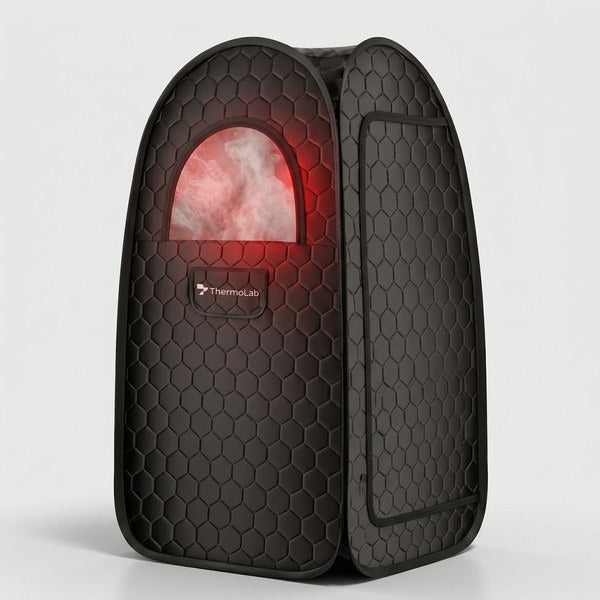
What makes this approach practical is that it no longer requires a gym membership or a construction project. A portable steam sauna sets up in a spare corner, folds down when not in use, and plugs into a standard outlet. A red light panel sits on a desk or mounts on a stand.
ThermoLab builds both ends of this protocol. The Aura 300W infrared red light panel delivers red and near-infrared wavelengths for targeted skin and joint sessions. The AuraCore 1200W 6FT steam sauna is a full-height enclosure that brings controlled steam heat into a room that was not built for it.
Browse the full ThermoLab range to see which combination fits your space and your routine.

