




Biohacking Your Morning Routine with Red Light Therapy
Biohacking Your Morning Routine with Red Light Therapy
Most morning routines fail for the same reason most training programs fail: they ask too much at a time of day when willpower is thin. The ones that survive stack onto something you already do.
Red light therapy suits this unusually well. A session is passive — you sit in front of a panel for ten to fifteen minutes and do whatever you were going to do anyway. No form to learn, no equipment to reset, no recovery cost. For people who treat their physiology as a system to be measured and adjusted, that low friction is the point.
Here is what the research says photobiomodulation does, why morning placement makes mechanistic sense, and how to build a protocol you will still be running in three months.
The Mechanism: Light as a Mitochondrial Input
Red light therapy is more accurately called photobiomodulation, and the term matters because it points at the mechanism. Red light in roughly the 630–680 nanometer range and near-infrared light around 810–850 nanometers penetrate skin and reach underlying tissue at useful intensities. Near-infrared travels deeper — through skin into muscle and, depending on the site, toward bone and joint structures.
Once absorbed, the primary accepted target is cytochrome c oxidase, the fourth complex in the mitochondrial electron transport chain. The working model is that light absorption displaces nitric oxide that has been inhibiting this complex, allowing electron transport to proceed more efficiently. Downstream consequences described in the literature include increased ATP production, a brief controlled burst of reactive oxygen species acting as a signaling event, and release of nitric oxide into surrounding tissue, which promotes local vasodilation.
For anyone who thinks in terms of levers, this is the appeal: you are not adding a substance to the system, you are applying a stimulus that appears to make existing cellular machinery run more efficiently. Studies have reported effects on local blood flow, inflammatory markers, muscle recovery metrics, and skin collagen density.
Two caveats. Dose matters, and the response is biphasic — underdosing does little, overdosing appears to reduce rather than increase benefit. And much of the mechanistic work comes from cell culture and animal models; the human trials that exist are generally small, with effects that are real but modest.
Why Morning
You can run a red light session at any hour. There are three arguments for putting it first.
Light is the body's primary timing signal. The circadian system takes its strongest cue from light hitting the retina, which is why morning outdoor light exposure has become standard advice for anyone trying to stabilize sleep timing. The direct research on red and near-infrared wavelengths as circadian anchors is less developed than the work on bright white and blue-enriched light, so a red light panel should not be treated as a substitute for getting outside. What it does do is add a consistent light-and-warmth signal at a fixed time — and consistency of timing is itself a strong circadian input, arguably more important than the specific spectrum.
Morning is when adherence is highest. A behavioral argument rather than a physiological one, but it matters more than most mechanisms. Because photobiomodulation effects are cumulative across weeks, the protocol you complete beats the theoretically optimal one you skip. Morning slots are protected by default in a way that 9pm slots are not.
Near-infrared and perceived energy. User reports of improved morning alertness are consistent, and there is early research on transcranial near-infrared light and cognitive measures. That work is genuinely preliminary — small samples, varied protocols, limited replication — and belongs under interesting rather than established. Worth logging your own response to; not yet a claim the literature supports strongly.
A Protocol That Holds Up
Timing. Within 30 to 60 minutes of waking, at the same time each day.
Distance. Six to twelve inches from the skin for most panels. Closer means higher irradiance and a shorter effective session; further means lower irradiance over a wider area. Check your panel's specifications rather than guessing — this is the single variable most people get wrong.
Duration. Ten to fifteen minutes per target area. Resist extending it. The biphasic dose response means longer sessions are not reliably better and may be worse.
Target selection. Pick one or two areas rather than trying to cover everything. Face and upper chest for skin. Quads, hamstrings, or shoulders if you are training. Specific joints if that is your issue. Rotating randomly across body parts gives you an inconsistent dose everywhere.
Frequency. Three to five sessions a week. Most published protocols run between three and five weekly sessions over six to twelve weeks before measuring outcomes. That is the timescale to plan on.
Eye protection. Follow the guidance that comes with your panel. Do not look directly into high-intensity LEDs.
Stacking It Properly
Red light therapy is a weak stimulus in isolation and a reasonable multiplier when it sits inside a routine that is already working. Useful pairings:
With outdoor light. Do the panel session indoors, then get outside for ten minutes. The outdoor exposure handles circadian anchoring; the panel handles tissue-level work. These are different jobs.
With mobility work. Doing hip or shoulder mobility in front of a panel costs you nothing extra in time and puts light on the tissue you are working on.
With heat, on a separate schedule. Sauna and red light act through unrelated mechanisms — thermal load versus photonic stimulus — so they do not compete. A common split is red light in the morning and a sauna session in the evening, where the post-sauna cooling curve supports sleep onset. Combining both into one morning block is possible but tends to be the first thing to get skipped.
With actual measurement. If you track sleep, HRV, or resting heart rate, establish two weeks of baseline before adding the panel, then hold everything else constant for eight weeks. Changing three variables at once teaches you nothing. This is the part that separates a protocol from a habit you have convinced yourself about.
What Not to Expect
Red light therapy is not a stimulant and will not substitute for sleep. It does not treat, cure, or prevent any medical condition. The research describes modest, cumulative, tissue-level effects over weeks of consistent exposure — not acute transformations.
If you take photosensitizing medication, including certain antibiotics, retinoids, and diuretics, check with your doctor first. The same applies if you have a photosensitive skin condition.
Treated as a low-cost addition to a routine that already includes sleep, training, and getting outside, it earns its ten minutes. Treated as the centerpiece, it will disappoint.
Choosing a Panel
The variables that matter are delivered irradiance at a stated distance, the wavelengths included, and coverage area. A panel honest about these numbers is more useful than one quoting a large wattage figure with no context.
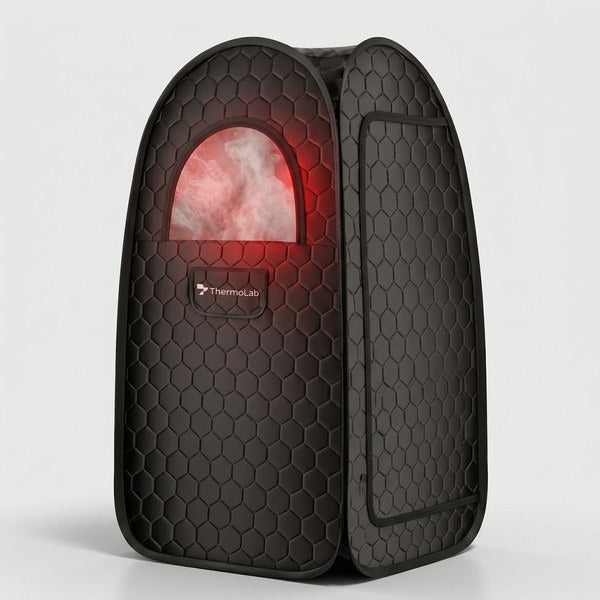
ThermoLab's Aura 300W infrared panel delivers both red and near-infrared wavelengths with published specifications, built for consistent daily sessions rather than occasional use. If you want to pair light work with thermal conditioning, the AuraCore 1200W 6FT steam sauna covers the other half of the stack.
See the full ThermoLab range and build the setup that fits your mornings.

